Tiny Kingdom
Build a village, raise a castle
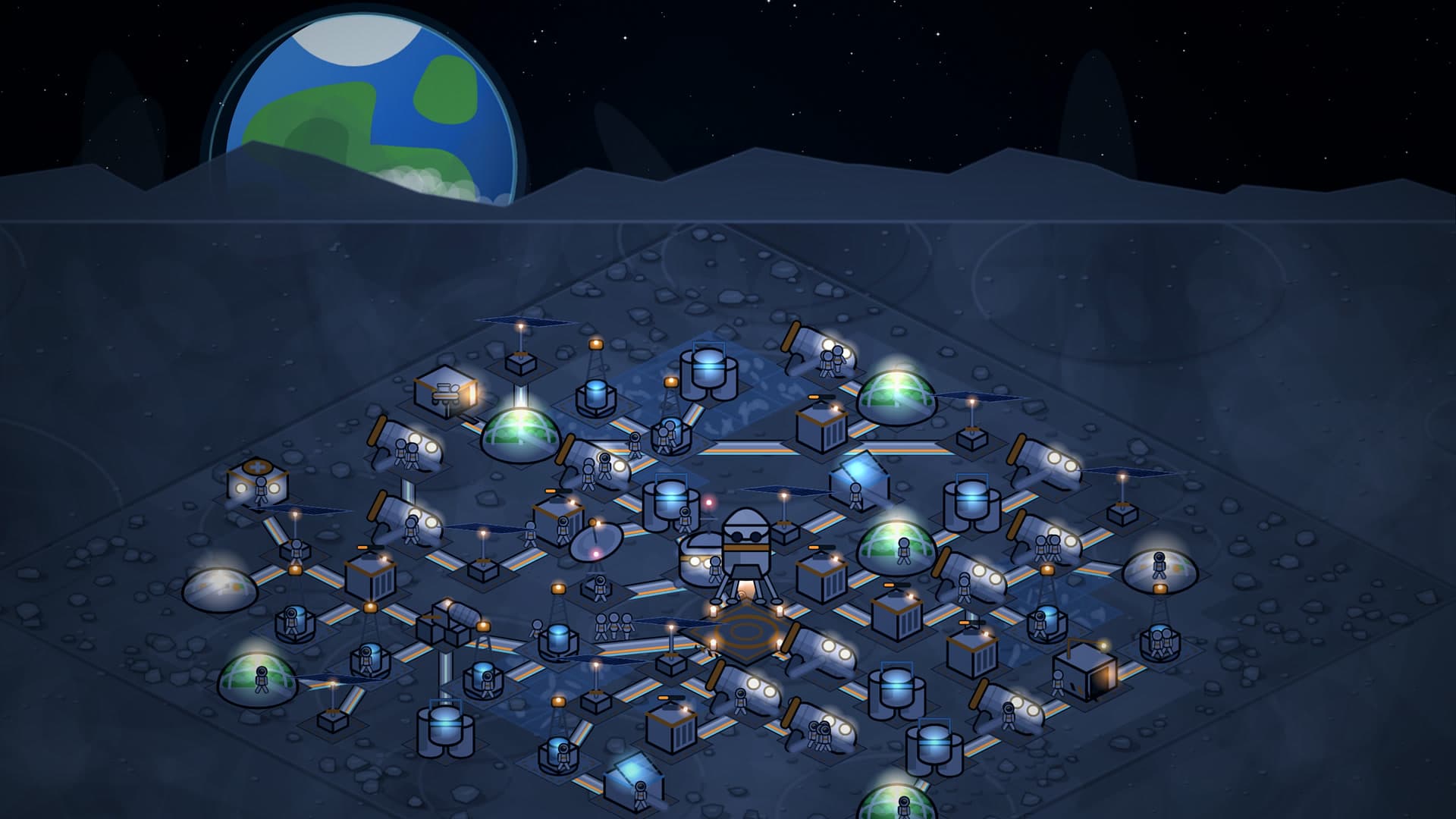

Land a command hub on grey regolith and grow it into a working colony. Every module has to be joined to the rest by a tube before power, air, water or food can reach it, and every network shows you exactly what it makes and what it owes. Get it wrong and the alarm lights start blinking.
Colony Moon starts with a command hub, a landing pad and two people. Everything else you build yourself, tile by tile, on a crater floor of soft grey dust, old boot prints and blue ice. Sixteen kinds of module are waiting in the build menu: solar arrays that tilt to follow the sun, battery banks, habitats, a greenhouse dome with rows of lettuce glowing inside, water extractors that only work standing on an ice patch, oxygen generators, a laboratory, a workshop, a rover bay, a comms dish and a landing pad for the shuttle. Nothing works until it is connected, so you drag a tube from one module to the next and watch the cable and the pipe run along beside it.
Four networks keep the colony alive: power, oxygen, water and food. Each one shows its supply and its demand live at the top of the screen, and each one is worked out per network, so a module left off the end of a tube has nothing at all. The day and night cycle runs about four minutes. In daylight the arrays carry the base and charge the batteries; at night the whole place runs off what you stored, lit only by earthlight and the warm windows of the habitats. Run out and the lowest-priority modules go dark, a red beacon starts blinking above them, and the crew get unhappy enough to ask for a seat on the next shuttle home.
Colonists arrive by shuttle whenever there is a bed and the life support is comfortably ahead of demand, and each one takes a trade: engineer, botanist, scientist, medic or technician. They bounce between modules in chunky white suits while a rover trundles out to patch whatever the last meteor shower cracked. Dust storms cut solar output, solar flares knock out your comms, and a supply capsule occasionally drops in with a pile of parts. Twelve research nodes make everything better — thinner panels, deeper cells, hydroponics, deeper drills, reclaimed water, bigger habitats — and the goal ladder asks for ten, then twenty-five, then fifty colonists thriving, which means every network in surplus for a whole day and night. It plays with a thumb on a phone and with the keyboard on a desktop, and it saves itself as you go.
Plan, build and outthink the other side.
Colony Moon
Keep the lights on, keep them breathing